
Cracked Pipe Boots: The Small Part Behind Big Roof Leaks
I’m Devin Orsi, owner of Peak Precision Contracting in Canonsburg. We’re a family-owned general contractor, a collective of tradespeople covering renovations inside and out, including roofing, siding, gutters, storm and insurance work, water mitigation, and mold remediation. Roof leak detection is my specialty, and our crew brings decades of combined experience to every roof we work on.
A lot of roof leaks start at a part most homeowners have never heard of: the pipe boot. When this small rubber collar around a plumbing vent pipe cracks, water runs straight down the pipe and into the house. If you’re in Upper St. Clair and you’ve noticed a stain on a bathroom or hallway ceiling after the fall rains, here’s what to look for and how it gets fixed. Estimates are free.
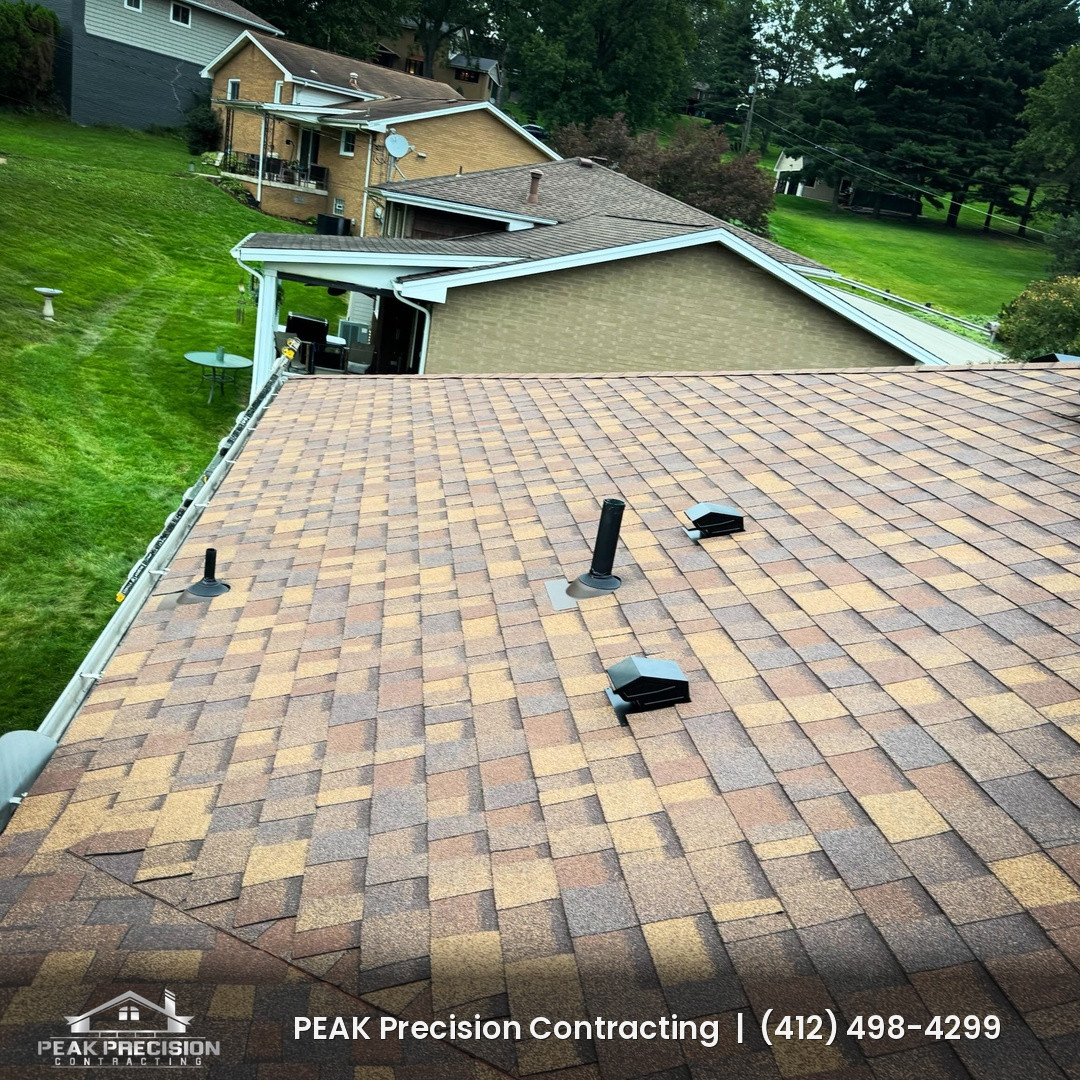
What a pipe boot does
Plumbing vent pipes run up through the roof so the drains can breathe, and each one leaves a hole that has to be sealed. A pipe boot (also called a vent boot or roof jack) does that job. It’s a flat flashing base that slides under the shingles above the pipe and sits on top of the shingles below, with a rubber collar that hugs the pipe.
The rubber collar is the weak point. After years of summer sun and winter freeze-thaw, it dries out, shrinks, and cracks, often before the shingles around it wear out. Once there’s a gap between the collar and the pipe, rain runs down the outside of the pipe, through the roof deck, and into your attic.
Signs you may have a cracked pipe boot
- A ceiling stain near a bathroom, kitchen, or laundry area. Vent pipes usually come up near plumbing fixtures, so leaks tend to show up close to them.
- It only drips in heavy or wind-driven rain. A small crack may stay dry in a light shower and leak in a downpour.
- Staining around the pipe in the attic. If you can get into the attic safely, look at the roof boards and the pipe where it comes through. Dark rings, damp wood, or wet insulation around the pipe are a strong clue.
- A visible gap or split from the ground. With binoculars, you can sometimes see a collar that’s cracked, torn, or pulled away from the pipe. Please don’t climb up to look.
Keep in mind that a ceiling stain doesn’t always sit directly under the leak. Water can travel along rafters and roof boards before it drips. That’s why I trace leaks from the attic and the roof surface together, instead of guessing from the stain.
What causes pipe boots to fail
- Age and weather. Sun, heat, and western PA freeze-thaw cycles break down the rubber over time.
- Critters. Squirrels sometimes chew on boots, especially soft lead ones.
- Installation problems. A boot set on top of the shingles above it, exposed nails that weren’t sealed, or a collar that’s the wrong size for the pipe can leak even when the boot is new.
- Old patches. A layer of caulk or roofing tar smeared over a cracked boot can buy a little time, but it dries out too and often traps water underneath.
How we fix a leaking pipe boot
For most homes, the right fix is replacing the boot, not patching it:
- Confirm the source. Before anything gets replaced, I check the attic and the roof to make sure the boot is actually the problem. Nearby flashing, vents, or shingles can leak too.
- Lift the shingles above the pipe. We carefully loosen the courses above the boot so the new flashing base can slide underneath, the way it’s supposed to sit.
- Install a new boot sized to the pipe. The new boot is fastened and sealed, the shingles are laid back down over the top of the flange, and any exposed fasteners are sealed.
- Check the other penetrations. While we’re up there, we look at every vent pipe and roof vent. If one boot has cracked, the others on the same roof are often the same age.
- Look at the damage inside. If water has soaked insulation, stained the roof deck, or damaged drywall, we’ll tell you what we found. As a full general contractor, we can handle drying, ceiling repair, and mold remediation too.
If you’re planning a full roof replacement, every pipe boot should be replaced at the same time. It’s one of the details I check on every roof we install.
Why fall is the time to deal with it
October rain and wind are often when a boot that cracked over the summer starts letting water in. Wet insulation and roof boards don’t dry out well once it gets cold, and lingering attic moisture is how mold gets started. Snow and ice sitting around a cracked collar can also keep feeding water into the same spot for weeks. A small repair before winter is a lot easier than a ceiling repair in February.
Serving Upper St. Clair and the South Hills
We’re based on South Central Ave in Canonsburg and work throughout Upper St. Clair, Bethel Park, Mt. Lebanon, Peters Township, South Fayette, and the rest of the South Hills and Washington County. See our roofing contractor in Upper St. Clair and roof repair pages for more on what we do locally, or our residential roofing page if your roof is due for replacement. For more, see our posts on installing a roof boot and why roof ventilation matters. If water is coming in right now, see our emergency roofing page.
Pipe boot leak FAQ
Can I just caulk around the pipe?
Caulk or roofing tar can slow a leak for a short time, but it dries out and cracks too. Replacing the boot is the lasting fix.
Is a pipe boot leak an emergency?
If water is actively dripping into the house, treat it as one. Put a bucket down, move belongings, and call us. We offer same-day emergency roof repair.
Does replacing a pipe boot mean I need a new roof?
Usually not. A boot can be replaced on its own if the shingles around it are in good shape. If the roof is near the end of its life, I’ll tell you honestly.
Will insurance cover a pipe boot leak?
Your policy decides. Many policies treat a worn-out boot as maintenance, while sudden storm damage may be handled differently. I’ll document what I find with photos so you have facts to share with your agent.
Seeing a stain near a vent pipe?
If you’ve got a drip, a stain, or a question about your roof in Upper St. Clair or anywhere in the South Hills, call Peak Precision Contracting at (412) 498-4299 or reach us through our contact page. I’ll find the source, show you what I see, and give you a free estimate. We won’t leave your doorstep until you’re satisfied.