
Roof Leak Detection in the South Hills: How We Find the Source (Not Just the Stain)
I’m Devin Orsi, owner of Peak Precision Contracting in Canonsburg. Roof leak detection is my specialty. If you’ve had a leak patched and it came back, there’s a good chance the patch went where the stain was. The problem is that a ceiling stain shows you where the water ended up, not where it got in.
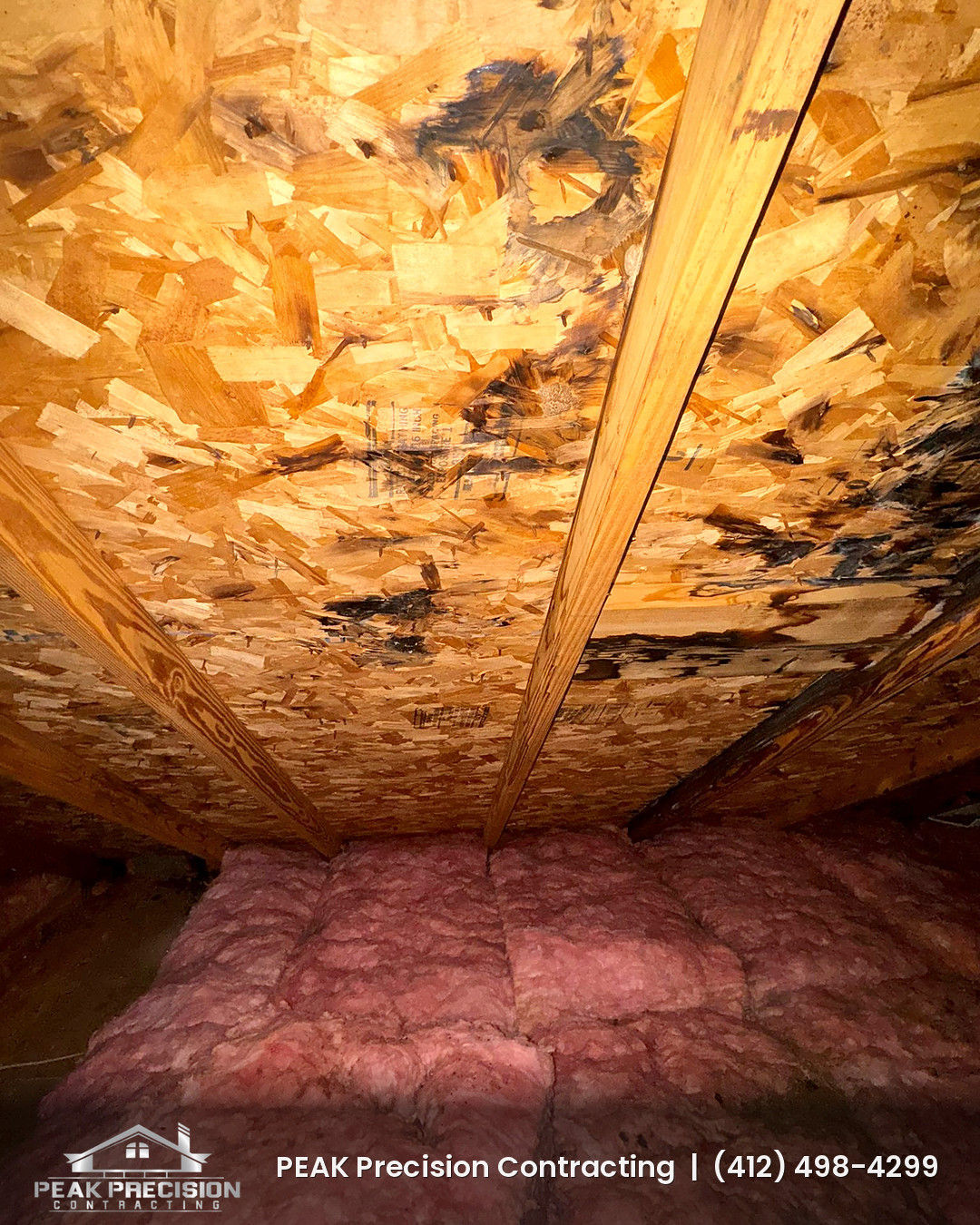
Here’s why that happens, how to read the clues, and how we trace a leak to its source across the South Hills.
Why the stain is almost never right under the leak
Water that gets past a shingle or a piece of flashing doesn’t drop straight down. It runs along the roof deck, rides a rafter or truss, or follows a vent pipe or chimney chase. By the time it soaks through drywall, it can be several feet from where it entered, sometimes in a different room.
That’s why a patch over the stain so often fails. A worn shingle near the wet spot gets sealed, the ceiling dries out, and the next hard rain proves the real opening was uphill the whole time.
Reading the stain: where it shows up and what usually causes it
A stain isn’t the answer, but it’s a good clue:
- Near an exterior wall or along the edge of a ceiling: often the eaves, from clogged gutters, damaged drip edge, or ice dams pushing meltwater under the shingles.
- Around or below a chimney: failed flashing, or the masonry itself, like a cracked crown or porous brick. A bead of caulk won’t fix either.
- In a line or a spot mid-ceiling, away from walls: check what’s uphill, like pipe boots, exhaust vents, and skylights.
- Below where two roof slopes meet: valleys carry the most water and collect leaves.
- Below a dormer or where an addition ties into the main house: wall-to-roof flashing and steep-to-low-slope transitions are common entry points.
- Only in the bathroom or right below an upstairs bathroom: it might not be the roof. A bath fan venting into the attic or a plumbing leak can look just like one.
Leaks that only show up in certain weather
When a leak happens tells me almost as much as where:
- Only in wind-driven rain: water is being pushed sideways or uphill under flashing, siding, or lifted shingles.
- Only in winter, or during a thaw: ice dams are the likely cause. Our post on Pittsburgh ice dams explains how they form.
- On cold mornings with no rain at all: that points to condensation in the attic from poor ventilation or warm, moist air getting up there, not a hole in the roof.
- Hours or days after the rain stops: water may be sitting in saturated insulation or a low spot on the deck and slowly working its way down.
What you can safely track before we get there
Stay off the roof. A few notes from inside make detection faster and more accurate:
- Keep a simple leak log. Write down the date, whether the rain was heavy or light, which way the wind was blowing, and how long after the rain started the drip appeared.
- Mark the stain. Trace the edge lightly in pencil and date it. If it grows past the line in the next storm, you know it’s active, not old.
- Take photos. Photograph the stain, any drips, and anything damaged. They help us, and they help if you end up filing an insurance claim.
- Look in the attic if it’s safe. With a flashlight, and staying on the joists or a walkway (never on the insulation between them), look for dark decking, wet insulation, or rusty nail tips above the problem area.
If water is actively coming in or a ceiling is sagging, skip the log. Move belongings away, keep people out from under the bulge, and call our emergency roofing line.
How we trace a leak to the source
Whether it’s a colonial in Upper St. Clair or a brick home in Mt. Lebanon, the approach is the same:
- Inside first. I start at the stain and in the attic, following water trails, staining, and wet insulation to see which direction the water came from and how far it traveled.
- Then uphill on the roof. I measure from a fixed point like a chimney or vent so the inside and outside line up, then check every penetration, seam, flashing, and valley in that path, not just the nearest shingle.
- Confirm before repairing. If the source still isn’t obvious, a controlled water test can confirm it: water runs on one section at a time, starting low and working up, while someone watches from inside.
- Show you what we found. I’ll show you photos of the problem and explain whether it’s a repair or whether the roof is at the point where replacement makes more sense.
Many leaks trace back to one failed detail, like a cracked pipe boot or loose step flashing, and a targeted roof repair fixes it. If the shingles are worn out across the whole roof, patching one spot won’t hold up, and I’ll tell you that straight. See our roof replacement page. Peak is an Owens Corning Platinum Preferred contractor.
Why South Hills roofs leak where they do
A few things about local homes and weather come up again and again:
- Mature trees. Leaves and needles pack into valleys and gutters, hold water against the roof, and back it up under the edge. Healthy gutters are part of leak prevention.
- Freeze-thaw winters. Snow that melts and refreezes along the eaves sets up ice dams and works flashing loose over time.
- Chimneys and dormers. Many older South Hills homes have brick chimneys, dormers, and additions, and each one adds flashing that can fail.
As a general contractor, we also repair what the leak damaged inside, like wet drywall, insulation, and paint, so you don’t need a second company. If a storm caused the damage, here’s what to do after storm roof damage. Your policy decides what’s covered, and I can document what I find.
Roof leak detection FAQ
Why does my ceiling only leak sometimes?
Leaks that appear only in wind-driven rain or winter thaws point to causes like lifted flashing or ice dams. A leak log helps narrow it down.
Could it be condensation instead of a leak?
It can. Moisture that shows up on cold mornings with no rain usually means an attic ventilation problem, not a hole in the roof.
Is the estimate free?
Yes. Estimates are free, and you’ll know the price before any work starts.
Which South Hills towns do you cover?
We work throughout the South Hills, including Bethel Park, Mt. Lebanon, Upper St. Clair, South Park, Bridgeville, and McMurray and Peters Township, plus our home base of Canonsburg.
Get the leak found, not just patched
If you’ve got a stain that keeps coming back or a drip nobody can explain, call me at (412) 498-4299 or request your free estimate online. We won’t leave your doorstep until you’re satisfied.
[…] that sounds familiar, our posts on why ceilings leak when it rains and how we track down a leak’s source go […]