
Exterior Steps and Railings Before Ice Season: A Washington, PA Homeowner’s Guide
The first hard freeze in Washington County changes how a house gets used. Mail, packages, groceries and holiday guests all come up the same front steps, often in the dark by late afternoon, and often after a morning of frost or freezing drizzle. A wobbly handrail or a chipped concrete step that was easy to ignore in September becomes a real hazard in December. With Thanksgiving two weeks away, mid-November is a practical time to walk your exterior steps, railings and landings and decide what needs attention before ice season.
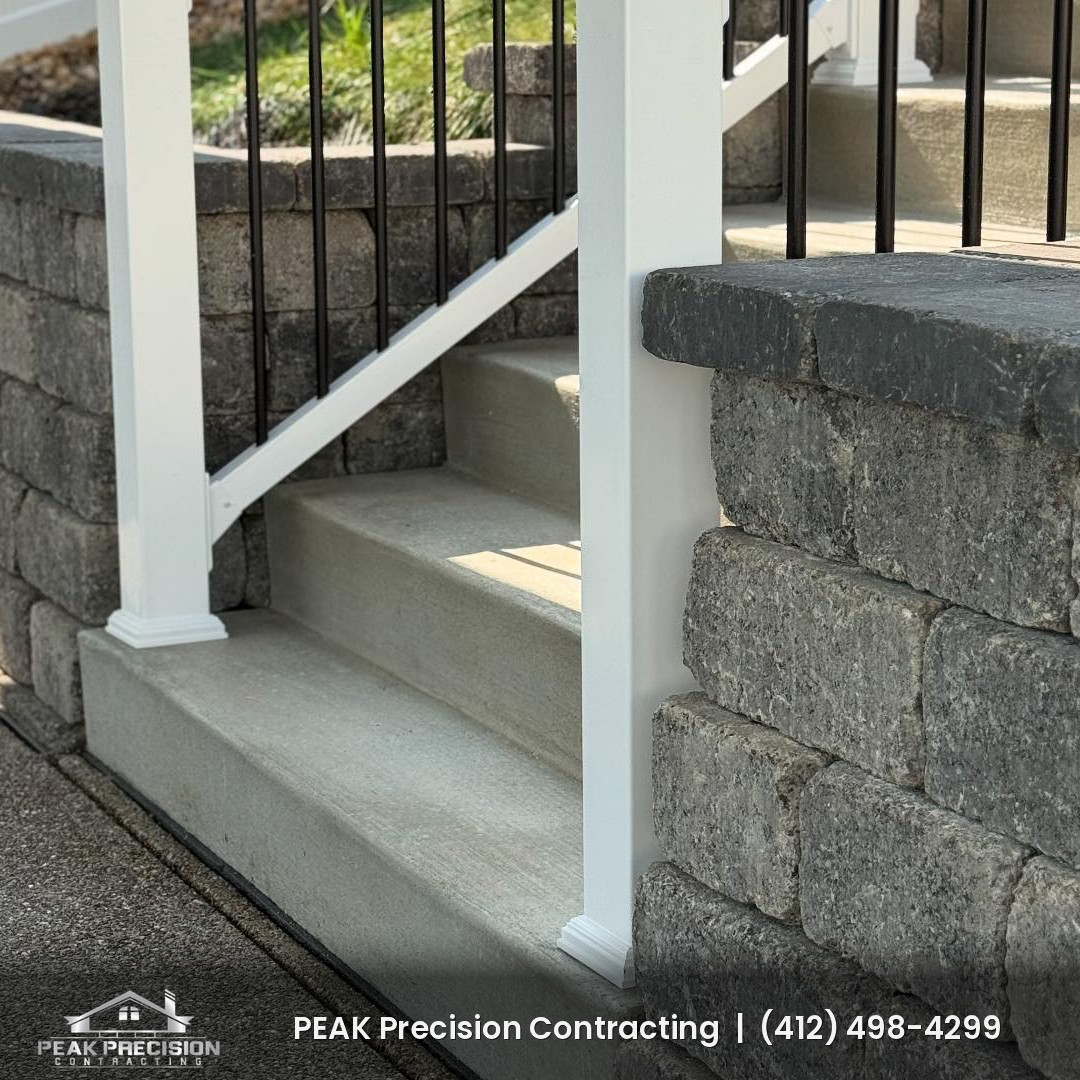
Why winter is hard on exterior steps
Our region swings above and below freezing many times each winter. Water gets into small cracks in concrete, mortar joints and wood connections, freezes, expands and opens the gap a little more. Each cycle makes the next one worse. On concrete steps that shows up as flaking or scaling on the surface, chipped edges on the nosings and cracks where the steps meet the house or the walk. On wood steps it shows up as loose treads, soft stringers and fasteners that back out of the posts.
Ice adds a second problem. Any step that holds water, whether from a low spot, a cracked tread or a downspout that dumps beside the stairs, can turn into a sheet of ice overnight. That is why a quick look at drainage around the entry is part of every step inspection we do.
A walk-around checklist for your steps and railings
– Grab each handrail and push it side to side. A rail that moves at the posts or pulls away from the wall needs attention now, not after it fails under someone’s weight.
– Look at the rail ends and posts where they meet the concrete or deck. Rust at the base of metal posts and rot at the base of wood posts are common failure points.
– Check every tread for cracks, spalled or crumbling edges and surface flaking.
– Watch for uneven steps. One riser taller or shorter than the rest is a classic trip hazard, especially for guests who do not use your stairs every day.
– Look for gaps where the steps or stoop have settled away from the foundation, and for places where water ponds on the landing.
– Note where downspouts and roof runoff land. Water discharging onto or beside a walkway refreezes on the steps.
– Check the lighting. Exterior stairways should be lit, and it gets dark before 5 p.m. this time of year.
What the code expects from handrails and guards
Pennsylvania’s Uniform Construction Code is based on the International Residential Code, and the IRC is a useful yardstick even for older homes. Under Section R311.7.8, stairs with four or more risers need a handrail on at least one side, with the top of the rail between 34 and 38 inches above the tread nosings, running continuously for the full flight. Section R312.1 requires guards on open-sided walking surfaces, including stairs, porches and landings, that are more than 30 inches above the grade below; most guards must be at least 36 inches high. The IRC also limits riser height to 7 3/4 inches and sets a 10-inch minimum tread depth, with no more than 3/8 inch of variation within a flight.
Older houses were not always built to those numbers, and existing stairs are not automatically out of compliance. But when we repair or rebuild steps, these are the targets we build to, and when a rail is missing on a tall flight, adding one is one of the most worthwhile small projects a homeowner can do. For homeowners planning to stay in their house long term, our guide to aging-in-place remodeling covers railings and safer entries in more detail.
Repair or rebuild?
Not every worn step needs to be torn out. Small surface cracks and minor edge chips can often be repaired, and a loose rail can usually be re-anchored or replaced on its own. A rebuild makes more sense when concrete steps have settled or tipped toward the house, when cracks run through the full depth of the step, when large sections are crumbling, or when wood stringers and posts are rotted. Our article on concrete repair versus replacement walks through the same decision for walks and slabs.
Timing matters too. Pouring new concrete in freezing weather takes extra precautions, so a full concrete rebuild sometimes makes sense as a spring project, with a safe temporary fix or a new rail installed now. Railings, wood steps and many repairs can be handled into the winter. If your entry is part of a porch or deck, see our guides to covered porch repair and deck repair before winter.
Be careful with ice melt on concrete
How you de-ice the steps affects how long they last. The National Ready Mixed Concrete Association advises avoiding deicing chemicals on newly placed concrete during its first winter and using clean sand for traction instead. After that, rock salt (sodium chloride) and calcium chloride are considered acceptable when used in moderate amounts, but products containing ammonium sulfate or ammonium nitrate, which are common fertilizer ingredients, should never be used as deicers because they attack the concrete surface. Shovel promptly so the melt has less to do, and keep fertilizer off your walks and steps. Our guide to preparing concrete for a Pittsburgh winter has more on sealing and care.
Frequently asked questions
Can you fix a loose railing in cold weather?
In most cases, yes. Re-anchoring or replacing a handrail does not depend on warm weather the way pouring concrete does, so it is a good project to handle before ice season.
Are cracked concrete steps a sign of a bigger problem?
Sometimes. Surface cracks are often cosmetic, but steps that have pulled away from the house or tilted usually point to settling or drainage issues underneath. We look at the base and the water around it, not just the crack.
Do you work outside Washington?
Yes. We serve Washington, Canonsburg, Cecil, Peters Township, McMurray, Upper St. Clair, Bethel Park, Bridgeville, South Fayette, Mt. Lebanon and the rest of the South Hills.
Exterior step and railing repair in Washington, PA
If your front steps, stoop or railings need attention before winter, call Peak Precision Contracting at (412) 498-4299 for a no-obligation estimate. We are a general contractor and collective of tradespeople, so concrete, masonry, carpentry, decks and porches are handled under one roof along with roofing, siding, gutters, storm and insurance claims, water mitigation, mold remediation and interior renovations. Since 2016 we have worked from 938 South Central Ave in Canonsburg, where you can visit our showroom, pick out samples and take them home. Our work is backed by optional warranties up to 25 years, separate from the Owens Corning manufacturer warranty on roofing products (see our warranty page), and we won’t leave your doorstep until you’re satisfied. PA HIC Registration #PA132469
Sources
– National Ready Mixed Concrete Association, CIP 2: Scaling Concrete Surfaces
Thinking about the roof over those steps too? See roof replacement in Washington, PA, or talk to a local roofer in Washington, PA.