
Attic Ventilation and Ridge Vents: A Bethel Park Homeowner’s Winter Guide
Once the furnace starts running for the season, Bethel Park attics go through a change most homeowners never see. Warm, damp air from the living space drifts upward, the roof deck above it turns cold, and whatever moisture the attic cannot get rid of starts to settle on nails, rafters and the underside of the sheathing. A well-ventilated attic handles that quietly. A poorly ventilated one can produce frost, damp insulation, mildew and stains on the ceiling that look exactly like a roof leak. This guide explains how attic ventilation works, how to tell if yours is falling short, and what a ridge vent actually does.
How attic ventilation is supposed to work
A vented attic is a simple system with two halves. Intake vents low on the roof, usually in the soffits under the eaves, let outside air in. Exhaust vents high on the roof, such as a ridge vent or roof-mounted vents, let air out. Warm air rises, so air enters at the eaves, sweeps up along the underside of the roof deck and leaves near the peak. That steady movement carries moisture out in winter and heat out in summer.
The trouble starts when one half is missing or blocked. An attic with a ridge vent but no working soffit intake has very little air to move. An attic with soffit vents covered by insulation is in the same position. In both cases the exhaust vent can end up pulling conditioned air from the house instead, which adds moisture to the attic rather than removing it.
Why ventilation matters more in a Pittsburgh-area winter
Our winters swing above and below freezing, often in the same week. When warm attic air meets a cold roof deck, two problems can follow. The first is condensation and frost on the underside of the sheathing, which melts on the next mild day and drips onto insulation and drywall. The second is uneven roof temperatures: a warm attic melts snow on the upper roof, the water runs down to the colder eaves and refreezes, and an ice dam forms. Our guide to ice dam prevention covers that side, including the role of air sealing and insulation.
What the building code asks for
The International Residential Code, which Pennsylvania uses as the basis for its Uniform Construction Code, sets the baseline in Section R806.2. The general rule is a minimum net vent area of 1/150 of the vented attic space. That can drop to 1/300 when the vents are balanced, with 40 to 50 percent of the required area in upper vents located no more than 3 feet below the ridge and the rest in the bottom third of the attic. In plain terms, the code favors a balanced system with real intake low and real exhaust high, not a few vents scattered wherever they fit.
Signs your attic is not venting well
– Frost or droplets on roofing nails and the underside of the roof deck on cold mornings
– Dark staining or mildew on rafters and sheathing, especially on the north side
– Damp, matted or compressed insulation
– Ceiling stains near exterior walls that appear after cold snaps rather than during rain
– Heavy icicles and ice buildup along the eaves
– Soffit vents painted over, clogged or buried by insulation from the attic side
Several of these overlap with roof leak symptoms, which is why we sort them out on site rather than guessing. If water is already coming through the ceiling, our guide to drywall repair after a leak covers what to do first.
What a ridge vent does, and what it cannot do
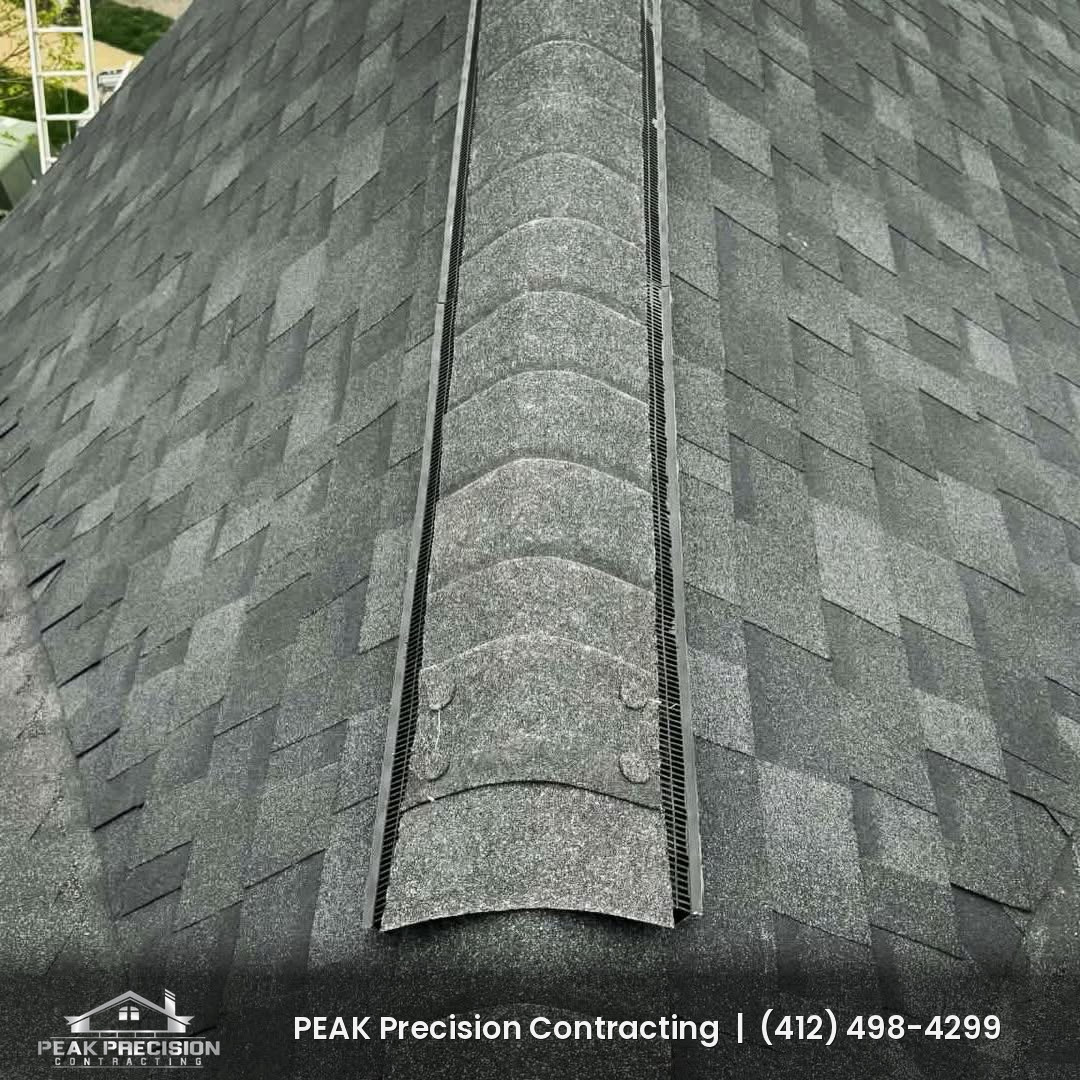
A continuous ridge vent is a vented strip installed over a slot cut along the peak of the roof, then covered with ridge cap shingles so it blends in, as in the photo above. Because it sits at the highest point and runs the length of the ridge, it lets warm, moist air out evenly instead of through a few hot spots.
A ridge vent only works with intake to match. If the soffits are solid, painted shut or blocked by insulation, a new ridge vent will not fix the problem on its own. Mixing exhaust types can also work against you. A ridge vent combined with gable vents or powered fans can short-circuit the airflow, pulling air from the nearest opening instead of from the eaves. When we plan a ridge vent, we look at the whole path from soffit to peak.
When to address ventilation
The most practical time is during a roof replacement, when the ridge is already open and the deck is exposed. That is when we can cut or extend the ridge slot, check the soffit intake and confirm the system is balanced before the new shingles go on. If you are weighing that decision, see our guides on roof repair or replacement and replacing a roof in winter.
Ventilation problems can also be fixed on a roof that still has life left. Clearing blocked soffits, adding insulation baffles so insulation stays out of the airflow path, or adding intake where none exists are all common repairs. If moisture has already caused damage, we handle the interior side too, from drywall and insulation to water mitigation and mold remediation.
Frequently asked questions
Can an attic have too much ventilation?
The bigger issue is usually imbalance rather than too much. Too much exhaust with too little intake can pull conditioned air out of the house. A balanced system sized to the attic is the goal.
Should I close my attic vents in winter to keep heat in?
No. Attic ventilation is meant to keep the attic close to outdoor temperature. Heat loss into the attic is better handled with air sealing and insulation at the attic floor.
Do you serve homes outside Bethel Park?
Yes. We work throughout Bethel Park, Upper St. Clair, Mt. Lebanon, Peters Township, McMurray, Canonsburg, Cecil, South Fayette, Bridgeville, Washington and the South Hills.
Attic ventilation and roofing in Bethel Park
If you are seeing frost in the attic, damp insulation or ceiling stains after cold weather, call Peak Precision Contracting at (412) 498-4299 for a no-obligation estimate. Roof leak detection is a specialty of ours, and we offer 24/7 emergency roof repair. We are a general contractor and collective of tradespeople covering roofing, siding, gutters, storm and insurance claims, water mitigation, mold remediation and interior renovations, and an Owens Corning Platinum Preferred contractor. Since 2016 we have worked from 938 South Central Ave in Canonsburg, where you can visit our showroom by appointment, pick out samples and take them home. Our work is backed by optional craftsmanship warranties up to 25 years, separate from the Owens Corning manufacturer warranty (see our roof warranty page), and we won’t leave your doorstep until you’re satisfied. PA HIC Registration #PA132469
Sources
– International Residential Code, Section R806.2 Minimum Vent Area (via UpCodes)