
Rotted Roof Decking: Soft Spots, Sagging and What Upper St. Clair Homeowners Should Know
Most Upper St. Clair homeowners never see their roof decking; from the yard you only see shingles. But the plywood or boards underneath hold the nails, carry the snow load and give the shingles a solid base. When that wood rots, the roof can look fine from the street while it slowly loses its grip. Mid-November, before snow and ice settle in for the season, is a good time to know the warning signs and what a repair really involves.
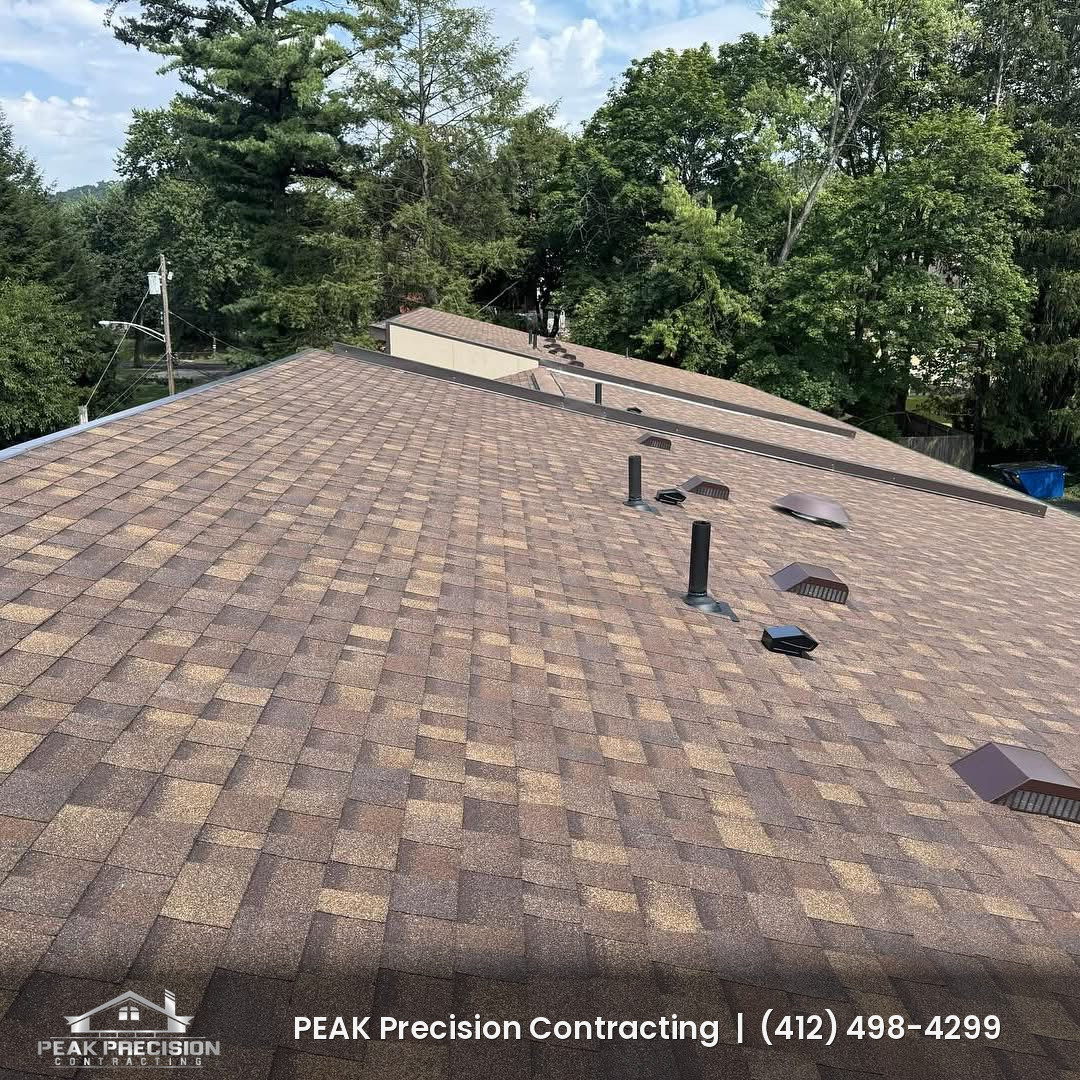
What roof decking is and why it matters
Roof decking, also called sheathing, is the layer of plywood, OSB (oriented strand board) or older plank boards fastened across the rafters or trusses. Everything else on the roof is attached to it. The International Residential Code requires asphalt shingles to be fastened to solidly sheathed decks (Section R905.2.1), and Pennsylvania’s Uniform Construction Code now follows the 2021 edition of that code for houses.
Shingle manufacturers set their own minimums too. Owens Corning’s installation instructions call for a minimum 3/8-inch plywood or 7/16-inch OSB deck, with panels spaced at least 1/8 inch and no more than 1/4 inch apart so the wood can expand and contract. When the deck is soft, delaminated or rotted, nails cannot hold the way they were designed to, and that affects how the roof stands up to wind.
Warning signs of rotted or damaged decking
– Soft or spongy spots. A section that gives underfoot usually means the wood below has been wet for a long time.
– A sagging or wavy roofline. Dips between rafters can point to weakened sheathing, although sagging can also come from framing problems.
– Dark stains or mold on the underside of the roof in the attic. Check around chimneys, vent pipes and valleys with a flashlight.
– Daylight or rusty nail tips in the attic. Rust on nails that poke through the deck is a sign of repeated moisture, either from leaks or from condensation.
– Water stains on ceilings or drywall, especially after heavy rain or snowmelt. Our guide to drywall repair after a leak covers what to do inside once the source is found.
What causes roof decking to rot
Decking rots because it stays wet. Common sources on South Hills homes are slow leaks at chimney and pipe flashing, ice dams that push meltwater under the shingles at the eaves, missing or damaged shingles after wind storms, and attics that trap warm, moist air in winter. Poor ventilation lets moisture condense on the cold underside of the deck, and over several winters that does the same damage as a leak. If your attic shows frost or dripping nails in January, read our attic ventilation and ridge vent guide and our post on ice dam prevention in Upper St. Clair.
Can you just put new shingles over a bad deck?
No. The residential code lists specific conditions where a new layer of roofing is not allowed over the old one, including any roof where the existing covering is water-soaked or deteriorated to the point that it is not an adequate base, and any roof that already has two or more layers (Section R908.3.1.1). A full roof replacement removes the existing layers down to the deck (Section R908.3), which is exactly when hidden rot shows up. Covering a soft deck traps the problem and usually shows up later as nail pops, buckled shingles and leaks.
How decking repair works during a roof replacement
On a typical replacement, the old shingles and underlayment come off first. With the deck exposed, we walk and inspect it section by section. Damaged panels or boards are cut back to solid framing and replaced with new sheathing of the correct thickness and spacing. If the damage traces back to the framing, a rafter or truss may need repair as well. Only after the deck is sound do the ice and water barrier, underlayment, flashing and shingles go on.
Because nobody can see the whole deck until the tear-off, a good estimate should explain how replacement sheathing is handled and priced if it is needed. Ask before you sign. See also roof repair or replacement.
Repairing decking in late fall and winter
Small areas of rotted decking around a leak can often be repaired along with the flashing or shingles that caused it, without waiting for spring. Full replacements can continue on suitable cold days; Owens Corning’s instructions include cold-weather steps such as hand-sealing perimeter shingles. See our guide to roof replacement in winter for what changes when temperatures drop. In Upper St. Clair, a roof replacement also involves the township permit process, which we covered in roof replacement permits in Mt. Lebanon and Upper St. Clair.
If water is actively coming in, do not wait. Our emergency roof leak steps explain what to do in the first few hours, and we offer 24/7 emergency roof repair. If storm damage caused the leak, we can help you document it and work through your insurance claim.
Frequently asked questions
How do I know if my roof decking is rotted?
Soft spots, a sagging roofline, dark stains or mold on the underside of the deck in the attic, and rusty nail tips are the most common signs. A roof inspection and a look in the attic usually confirm it.
Does every roof replacement need new decking?
No. Decking that is solid, dry and properly fastened can stay. Only damaged or undersized sections need to be replaced, and that is decided once the old roof is off.
Will homeowners insurance pay for rotted decking?
It depends on the cause and your policy. Sudden storm damage is treated differently than rot from a long-term leak. We can help document what we find; your insurer makes the coverage decision.
Do you work outside Upper St. Clair?
Yes. We serve Upper St. Clair, Bethel Park, Mt. Lebanon, Peters Township, Canonsburg, Cecil, South Fayette, Bridgeville, Washington and the rest of the South Hills.
Roof decking repair in Upper St. Clair, PA
If you have noticed soft spots, sagging or attic stains, call Peak Precision Contracting at (412) 498-4299 for a no-obligation estimate. We are a general contractor and collective of tradespeople, and roof leak detection is our specialty, so we look for the source of the water, not just the damaged wood. As an Owens Corning Platinum Preferred contractor, we also handle siding, gutters, storm and insurance claims, water mitigation, mold remediation and interior renovations. Since 2016 we have worked from 938 South Central Ave in Canonsburg, where you can visit our showroom by appointment, pick out samples and take them home. Our work is backed by optional craftsmanship warranties up to 25 years, separate from the Owens Corning manufacturer warranty on roofing products (see our warranty page), and we won’t leave your doorstep until you’re satisfied. PA HIC Registration #PA132469
Sources
– International Residential Code 2021, Section R908.3.1.1 Roof recover not allowed (UpCodes)
– Owens Corning Technical Bulletin: Roof Deck Requirements for Installation of Asphalt Shingles