
Flat Roof Leaking in Winter? A Mt. Lebanon Guide to Low-Slope Porch, Addition and Garage Roofs
Many Mt. Lebanon homes have at least one roof that is nearly flat: a porch roof under a second-story window, a rear kitchen or sunroom addition, a garage, or a dormer tied into a pitched main roof. These low-slope sections behave differently from shingled roofs, and winter is when their weak spots show. Here is what causes most flat roof leaks and what to do about them.
Why flat roofs leak differently
A shingled roof sheds water quickly because of its pitch. A low-slope roof relies on a continuous membrane, such as EPDM rubber, modified bitumen or a thermoplastic sheet, plus enough slope and drainage to move water off before it can find a weak seam.
The International Residential Code, the basis of Pennsylvania’s residential building code, reflects that difference. Asphalt shingles may only be used on slopes of 2 in 12 or steeper, with double underlayment required up to 4 in 12. Built-up, modified bitumen and single-ply membrane roofs need a design slope of at least 1/4 inch per foot for drainage, and unless a roof drains over its edges, the code calls for a roof drain at each low point. When an old porch or addition was built flatter than that, or the framing has sagged, water has nowhere to go.
Ponding water: the 48-hour rule
The National Roofing Contractors Association (NRCA) defines ponding as water that stays in low areas of a roof more than 48 hours after precipitation, under conditions that allow drying. A puddle gone in a day is normal; water that sits for days is a warning sign.
NRCA’s technical guidance explains why: ponded water can speed up membrane deterioration, collect debris, and, in cold weather, freeze into ice that can damage or split some membranes. In Mt. Lebanon, where freeze-thaw cycles repeat all winter, a low spot that holds water in November can hold ice in January.
Where flat roof leaks usually start
The source of a low-slope leak is rarely the middle of the membrane. The usual suspects:
– Seams and laps where membrane sheets overlap and the adhesive or tape has aged and let go.
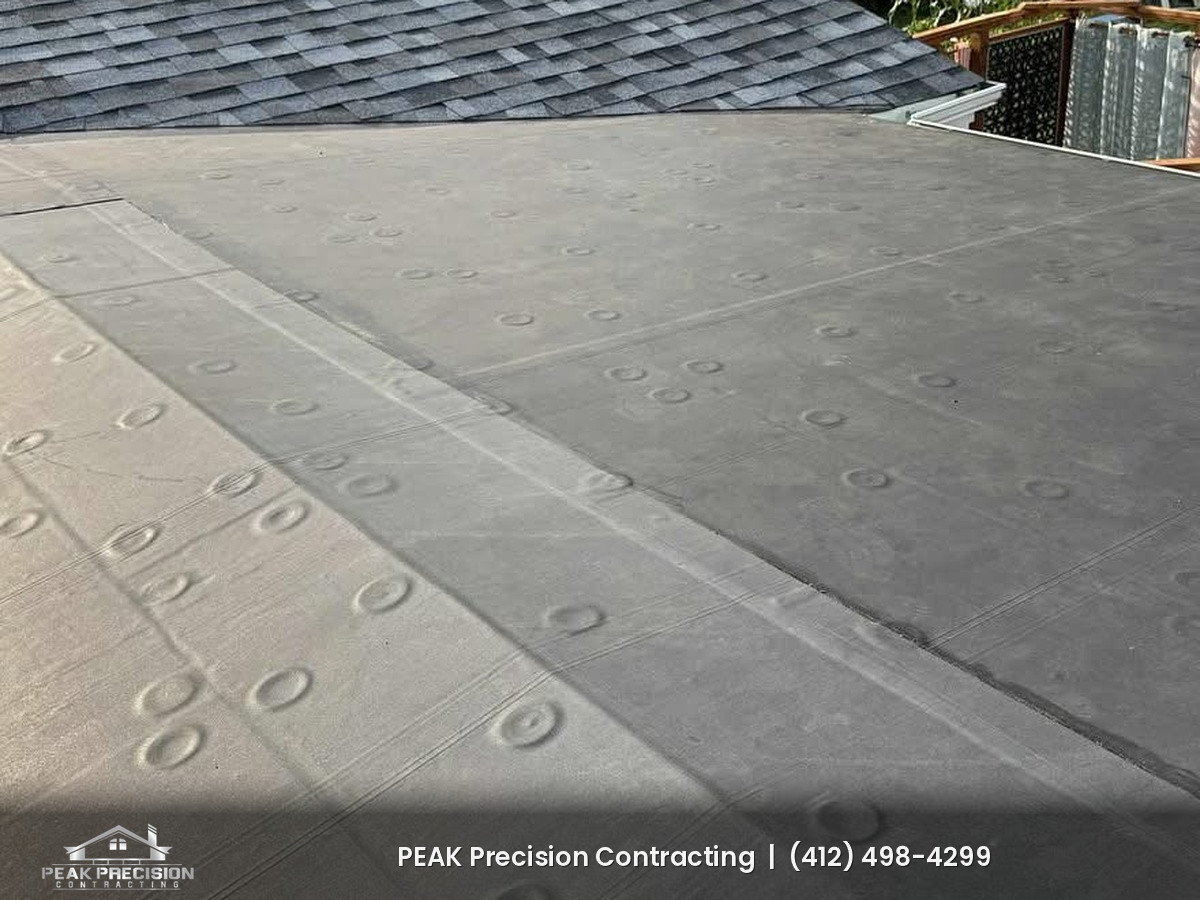
– Transitions where the flat section meets a pitched shingle roof or a wall, the spot in the photo above. Snow slides off the upper roof and piles here, and meltwater runs along the joint.
– Wall and parapet flashing on additions tied into brick or siding, where counterflashing has pulled away or caulk has dried out.
– Penetrations such as vent pipes, exhaust fans and skylights cut through the membrane.
– Drains, scuppers and gutters clogged with leaves, which turn the whole roof into a shallow pool.
– Punctures and blisters from foot traffic, fallen limbs, shoveling with a sharp tool, or trapped moisture lifting the membrane.
Winter warning signs inside and out
From a second-story window you can often spot:
– Standing water or ice patches that never seem to dry out
– Dark rings or debris lines on the membrane where water has sat
– Seams that look lifted, wrinkled or bubbled
– Gutters or scuppers overflowing at the low edge
Inside, look at the ceiling below the flat section: brown rings, peeling paint, sagging drywall, or a musty smell in the porch, sunroom or back room. Low-slope leaks can travel along the framing before showing up, so the stain is not always directly under the bad spot. Please do not walk on an icy roof to check.
What to do if your flat roof is leaking now
– Catch the water with a bucket and move furniture and electronics out of the way.
– If a ceiling is bulging with water, keep people out from under it and call for help.
– Take photos of the ceiling, the roof and any storm damage, with dates.
– Dry wet materials quickly. Drywall and insulation that stay wet can grow mold, which is why we also handle water mitigation and mold remediation.
If water is coming in fast during a storm, our 24/7 emergency roof repair service can tarp or temporarily seal the area until a permanent repair is possible.
Repair, recover or replace?
A single failed seam or a cracked boot around a vent pipe can often be repaired. If the membrane is brittle, split in several places or has wet insulation underneath, a full replacement usually makes more sense. Code also limits shortcuts: a new roof cannot be laid over an existing one that is water-soaked or deteriorated, or over a roof that already has two or more layers. Where a section was built too flat, replacement is the time to add tapered insulation or correct the framing so water drains properly. Our flat and commercial roofing page explains the membrane systems we install, and the Mt. Lebanon roof repair page covers our local repair work. For more winter roof issues, see how much snow a roof can hold and ice dam prevention. Planning a replacement? See our guide to roof replacement permits in Mt. Lebanon and Upper St. Clair.
How we find the source
Roof leak detection is our specialty. On a low-slope roof we check the seams, transitions, flashing, penetrations and drainage, look for soft or wet areas that point to trapped water, and check the ceiling and framing below. Then we show you what we found and what it will take to fix it. If storm damage caused the leak, we can document it and help you through the insurance claim; your insurer decides coverage, and we never offer to cover or waive a deductible.
Frequently asked questions
Is some standing water on a flat roof normal?
Short-term puddles after rain are common. NRCA treats water still standing more than 48 hours after precipitation, in drying conditions, as ponding that should be addressed.
Can a flat roof be repaired in winter?
Temporary repairs and tarping can be done in cold weather. Some permanent membrane work needs a dry stretch and suitable temperatures.
Do you work in Mt. Lebanon?
Yes, along with Upper St. Clair, Bethel Park, Dormont, Scott Township and the rest of the South Hills. See our Mt. Lebanon roofing page.
Flat roof repair in Mt. Lebanon
Water under your porch roof, addition or garage this winter? Call Peak Precision Contracting at (412) 498-4299 or request a no-obligation estimate. We are a general contractor and collective of tradespeople covering roofing, siding, gutters, interior and exterior renovations, storm and insurance claims, water mitigation and mold remediation. As an Owens Corning Platinum Preferred contractor, we also offer 24/7 emergency roof repair. Since 2016 we have worked from 938 South Central Ave in Canonsburg, where you can visit our showroom by appointment, pick out samples and take them home. Our work is backed by up to 25-year craftsmanship guarantees, separate from the up to 50-year limited lifetime manufacturer warranty on roofing through Owens Corning (see our warranty page), and we won’t leave your doorstep until you’re satisfied. PA HIC Registration #PA132469
Sources
– International Residential Code 2018 (Pennsylvania), Chapter 9 Roof Assemblies (R903.4, R905.2.2, R905.9.1, R905.11.1, R905.12.1, R905.13.1, R908.3.1.1), via UpCodes
– NRCA Roofing Guidelines Glossary: Ponding
– NRCA, The importance of proper roof slope