
Roof Leaking Where Two Slopes Meet? A Bethel Park Guide to Roof Valley Leaks
Some of the hardest roof leaks to pin down start in a valley, the inside corner where two roof slopes meet. On many Bethel Park homes that is where a garage roof, dormer or addition ties into the main roof. A valley collects water from two slopes at once, plus leaves, snow and ice in late fall and winter. Here is why valleys leak, what to look for and how a valley is repaired the right way.
Why valleys are a common leak point
A valley is a channel: rain and snowmelt from two roof planes funnel into it on the way to the gutter. Owens Corning’s roofer’s guide puts it plainly: whatever type of valley is used, it must be smooth, unobstructed, large enough to carry water away rapidly and able to withstand occasional backing up of water. When any part of that breaks down, water finds its way under the shingles.
Installation shortcuts often show up in a valley first. And because valley water can travel along the deck or a rafter before it drips, the stain inside is often several feet from the real entry point.
The three valley types and what can go wrong
Shingle roofs use one of three valley styles:
– Open valley: a strip of metal is left exposed down the center, and the shingles on each side stop short of it.
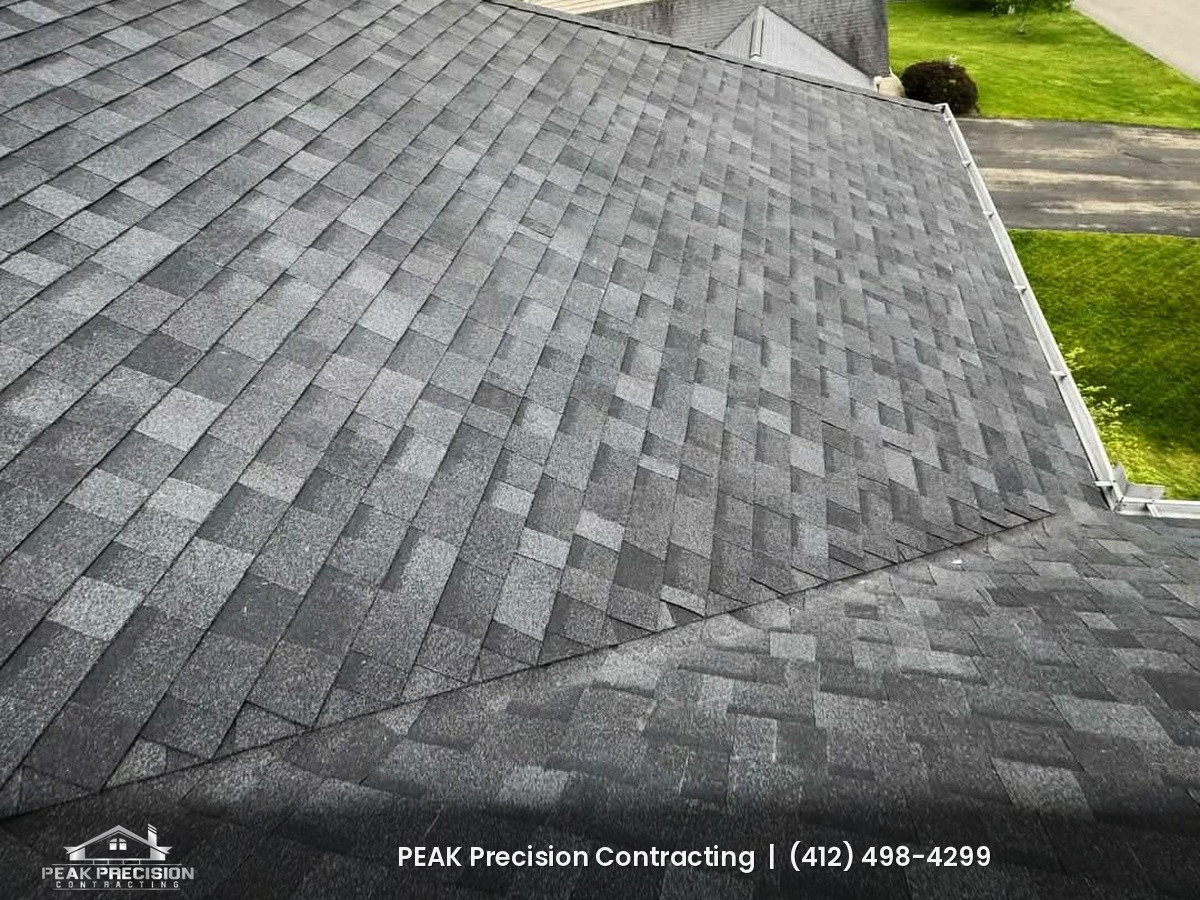
– Closed-cut valley: shingles from one slope run across the valley, and shingles from the other slope are trimmed in a straight line just off the centerline, like the valley in the photo above.
– Woven valley: shingles from both slopes are interlaced across the valley.
Whatever the style, the International Residential Code adopted in Pennsylvania (Section R905.2.8.2) requires a valley lining under the shingles. For an open metal valley, the lining must be at least 24 inches wide. For a closed valley, it can be a 36-inch-wide layer of smooth roll roofing or a self-adhering polymer-modified bitumen underlayment meeting ASTM D1970.
Owens Corning’s Duration shingle instructions add detail for a closed-cut valley: run the first side at least 12 inches past the centerline, keep fasteners at least 6 inches from the centerline, trim the second side 2 inches off the centerline, and clip the upper corners of the trimmed shingles and set them in roofing cement.
When we trace a valley leak, we look for:
– No valley lining, or a lining that is too narrow or has failed with age.
– Nails driven too close to the center of the valley, where water runs heaviest.
– Trimmed shingles with square upper corners that let water slip sideways under the course.
– Worn, cracked or granule-bare shingles in the valley.
– A valley that empties against a wall, dormer or chimney without proper flashing.
Why late fall and early winter make valley leaks worse
By Thanksgiving, most of the leaves in Bethel Park are down, and valleys are where they pile up. Wet leaves or pine needles act like a small dam, pushing water sideways under the shingle edges, and the debris that washes down clogs the gutter right where the most water arrives.
Snow behaves the same way. It slides and drifts into valleys, and when daytime melt turns back to ice overnight, ice can build up in the valley and along the eaves below it. That is one reason the building code (Section R905.1.2) calls for an ice barrier at the eaves in areas with a history of ice forming there. Our guide to ice dam prevention explains how attic heat contributes, and our attic ventilation guide for Bethel Park covers the ventilation side.
Signs your valley may be leaking
– A ceiling stain near an inside corner of a room, or below where a dormer, garage roof or addition meets the house.
– Drips only in heavy, wind-driven rain or during snowmelt.
– Damp decking, wet insulation or rusty nail tips in the attic under the valley.
– From the ground: debris piled in the valley, shingles that look worn or lifted along the valley line, or gutters that overflow at the valley outlet.
– Soft spots near the valley, a sign of rotted roof decking.
How we find and fix valley leaks
Roof leak detection is one of our specialties. We start in the attic when we can, follow the water trail up the deck and confirm the entry point on the roof, because valleys, chimneys, pipe boots and wall flashing can all produce similar stains.
The fix may be clearing debris and replacing worn shingles, or tearing out the valley and rebuilding it with a new lining, new metal where used, and correctly trimmed and fastened shingles. If the rest of the roof is near the end of its life, we will tell you whether a roof replacement in Bethel Park makes more sense than another repair.
If water has reached the ceiling or insulation, drying matters as much as the roof repair. Our water mitigation and mold remediation services handle what happens inside, and our drywall repair guide explains the rebuild. After storm damage, we work as insurance claim specialists and document it for your adjuster; see our storm damage and insurance claims page. Your policy decides coverage, and we never offer to cover or waive a deductible.
What you can do now
– Check your valleys from the ground with binoculars after the last leaves fall.
– Keep the gutters at the bottom of each valley clear; gutter guards can help on heavily wooded lots.
– After a heavy rain, check the attic under each valley with a flashlight.
– Stay off a wet, icy or snow-covered roof. Valleys are slippery and steep.
– If water is actively coming in, call for 24/7 emergency roof repair.
Frequently asked questions
Can a leaking valley be repaired without replacing the whole roof?
Often, yes. A valley can usually be rebuilt on its own when the rest of the roof is in good condition.
Is an open or closed valley better?
Both work when installed to code and to the manufacturer’s instructions. Owens Corning notes that open or closed-cut valleys are preferred for laminated shingles.
Do you work in Bethel Park?
Yes, along with Upper St. Clair, Mt. Lebanon, Peters Township, Canonsburg and the rest of the South Hills.
Roof valley leak repair in Bethel Park
Seeing a stain below a valley? Call Peak Precision Contracting at (412) 498-4299 or request a no-obligation estimate. We are a general contractor covering roofing, siding, gutters, interior and exterior renovations, storm and insurance claims, water mitigation and mold remediation, and an Owens Corning Platinum Preferred contractor. Since 2016 we have worked from 938 South Central Ave in Canonsburg, where you can visit our showroom by appointment, pick out samples and take them home. Our work is backed by up to 25-year craftsmanship guarantees, separate from the up to 50-year limited lifetime manufacturer warranty on roofing through Owens Corning (see our warranty page), and we won’t leave your doorstep until you’re satisfied. PA HIC Registration #PA132469
Sources
– International Residential Code 2018 (Pennsylvania), Chapter 9 Roof Assemblies, Sections R905.1.2 and R905.2.8.2, via UpCodes
– Owens Corning, Duration Series Shingles Installation Instructions (valley construction)
– Owens Corning, Roofer’s Guide (valleys)