
Mold in Your Home This Winter? When Canonsburg Homeowners Need Remediation
Once the heat comes on and the house gets closed up for the season, the damp basement corner, the musty closet on an outside wall or the bathroom ceiling that never quite dries can start to show dark spots. For Canonsburg homeowners, the question is whether it is a small spot you can handle yourself or a job that needs mold remediation. Here is how to tell the difference, what remediation involves and how to keep mold from coming back.
Why mold shows up in winter
The U.S. Environmental Protection Agency explains that mold spores are always present in indoor air and dust, but they will not grow without moisture. In a Washington County winter, that moisture usually comes from a few places.
Condensation on cold surfaces. Warm indoor air meets a cold exterior wall, foundation or closet corner, and water collects on the surface.
Bathroom and kitchen moisture with nowhere to go. A bath fan that is undersized, unused or ducted into the attic keeps moisture in the house.
Slow leaks that went unnoticed in the fall. Failed roof flashing, a dripping supply line or a basement wall that took on water can stay damp for weeks behind drywall or under carpet.
Humidifiers set too high. The EPA recommends keeping indoor relative humidity below 60 percent, ideally between 30 and 50 percent.
Small spot or a remediation job?
Size is the first thing the EPA looks at. Its guidance says that if the moldy area is less than about 10 square feet, roughly a 3 foot by 3 foot patch, most homeowners can handle the cleanup themselves. Once mold covers more than 10 square feet, or there has been a lot of water damage, the EPA points homeowners to its more detailed remediation guidance.
Size is not the only factor. These situations generally call for a professional:
The mold is in or behind building materials. Mold in drywall, insulation, carpet pad or subfloor usually means those materials have to come out.
The water came from sewage or a contaminated source. The EPA specifically recommends a professional with experience in contaminated water in that case.
The heating and cooling system may be involved. If the system may be contaminated, the EPA advises against running it, since it can spread mold through the house.
Anyone in the home has health concerns. The EPA recommends consulting a health professional before starting cleanup.
It keeps coming back. Mold that returns after cleaning almost always means the moisture source was never fixed.
What mold remediation actually involves
The EPA notes that if you clean up mold but do not fix the moisture source, the mold will most likely come back. That is why our team treats remediation as a construction problem first:
1. Find the moisture source. Roof leak detection is a specialty of ours, so we trace water back to where it actually enters.
2. Contain the work area. For larger areas, the EPA’s remediation guidance describes containment with polyethylene sheeting. Limited containment is generally recommended for 10 to 100 square feet, and full containment above that.
3. Remove damaged materials. Porous materials with mold growth, such as drywall, insulation, carpet and ceiling tile, are bagged and removed rather than painted over.
4. Dry the structure. Framing needs to be fully dry before anything is closed back up.
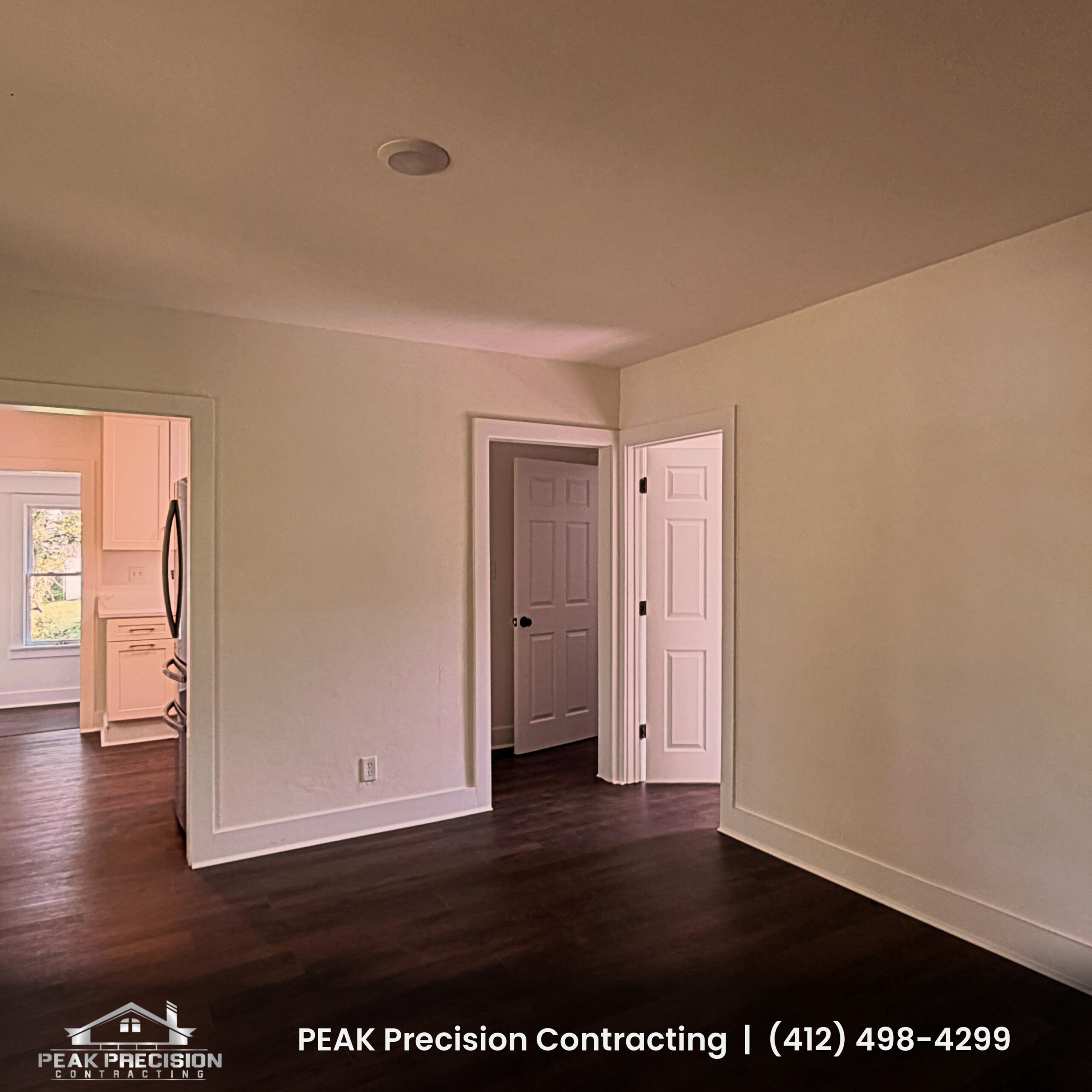
5. Fix the cause and rebuild. The same team repairs the leak, replaces drywall and insulation, installs flooring and trim, and paints so the room matches the rest of the house.
Peak Precision Contracting is a collective of tradespeople, so the roofing, drywall, flooring and finish work stay under one general contractor. Our renovation services in Canonsburg cover the interior rebuild side of that work.
Where we look first
In Canonsburg-area homes we look closely at basement walls behind finished drywall, closets on exterior walls, ceilings below bathrooms, attic sheathing above bath fans and the area around chimneys and roof penetrations. Bath fans matter more than many homeowners realize. Pennsylvania’s Uniform Construction Code adopts the 2021 International Residential Code, and section M1501.1 says exhaust air must be discharged to the outdoors and not into an attic, soffit, ridge vent or crawl space. A fan venting into a cold attic all winter can lead to frost and, eventually, mold on the roof sheathing. Our post on ice dam prevention covers how attic ventilation and insulation affect the roof in winter.
How to prevent mold this winter
Run bath fans during and after every shower. Keep a humidity meter in the basement and aim for that 30 to 50 percent range. Keep downspouts directed away from the foundation. Dry any leak or spill within 24 to 48 hours, which the EPA says prevents mold growth in most cases. If a pipe bursts or a fixture fails, our guides on preventing frozen pipes and handling a water heater leak walk through the first steps.
If moisture is coming through the roof, do not wait for spring. Our 24/7 emergency roof repair team can stop active leaks during the winter months.
Will insurance cover mold?
It depends on your policy and on what caused the moisture. Mold that results from a sudden, covered water loss is treated differently from mold caused by long-term humidity or a slow leak, and many policies limit mold coverage. Your policy language and your adjuster decide coverage. As insurance claim specialists, we can document the damage, prepare a detailed scope and meet with your adjuster on site. We never offer to cover or waive a deductible, and you should be cautious of any contractor who does.
Frequently asked questions
Can I just paint over mold?
No. The EPA says not to paint or caulk moldy surfaces, because paint over mold is likely to peel. Remove the mold and fix the moisture first.
Is bleach enough to clean mold?
For small spots on hard surfaces, the EPA recommends scrubbing with detergent and water and drying completely. Never mix bleach with ammonia or other cleaners.
How big an area can I clean myself?
The EPA’s rule of thumb is less than about 10 square feet. Larger areas, contaminated water or mold inside walls are better handled by a professional.
Mold remediation and repair in Canonsburg, PA
If you are seeing mold or dealing with water damage that never fully dried, call Peak Precision Contracting at (412) 498-4299 for a no-obligation estimate. Since 2016 we have served Canonsburg, Peters Township, Cecil, Washington and the South Hills from 938 South Central Ave, where you can visit our showroom by appointment to pick out flooring and finish samples for the rebuild and take them home. Our work is backed by optional craftsmanship warranties up to 25 years, and we won’t leave your doorstep until you’re satisfied. PA HIC Registration #PA132469